KAWASAKI 152355 Front Rear Wheel Rim
fits model: 250r, Ex250, 250, Ninja. make: Kawasaki. year: 1988–2007.
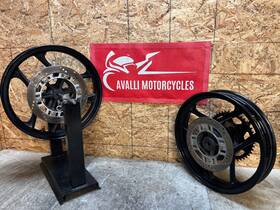
( Manufacturer Part Number: 152355 ), ( Model: 250 250R EX250 ), ( Manufacturer Warranty: No ), ( Wheel Diameter: 17 ), ( Wheel Width: 1.5 ), ( Country Of Origin: Japan ), ( Type: Rim ), ( Machine Type: Street Motorcycle ), ( Wheel Material: Aluminum )
Review KAWASAKI Front And Rear Wheels Wheel Rim Rims Pair fits NINJA 250R EX250 250 1988–2007
The Kawasaki Ninja 250 (and its variant, the EX250) from the model years 1988 through 2007 represents a legendary chapter in sportbike history, blending raw performance, timeless styling, and a cult following that has endured for decades. This iconic machine, originally introduced as the Ninja 250 in 1988, was Kawasaki s first foray into the high-performance sportbike market, and its influence can still be felt in modern motorcycle design. The EX250, a more rugged and adventure-oriented variant, was introduced later in the series, catering to riders who sought a balance between sport and off-road capability. Both models share a striking, angular fairing design that defines the era, with sharp lines, a sleek windscreen, and a bold, aggressive stance that turns heads even today. The front and rear wheels of these bikes are a key component of their character, featuring a unique and durable wheel setup that has become synonymous with the Ninja s legacy.
The front wheel assembly on the Kawasaki Ninja 250 and EX250 typically consists of a lightweight, high-quality steel rim paired with a reliable disc brake system, often featuring a single-piston caliper and a sturdy rotor. The rims are designed to be both functional and stylish, with a classic, slightly rounded profile that complements the bike s sporty aesthetic. The rear wheel, meanwhile, is equally robust, built to handle the bike s spirited performance and the occasional off-road excursion in the case of the EX250. Both wheels are constructed with precision, ensuring smooth rolling and minimal vibration, even at high speeds. The rims themselves are often finished in a polished or matte black, though some models may feature subtle chrome accents or unique paint schemes, adding to their vintage appeal. Over the years, Kawasaki made subtle refinements to the wheel design, but the core aesthetic and functionality remained largely unchanged, preserving the bike s retro charm while maintaining reliability.
For enthusiasts and collectors, the wheels and rims of the Kawasaki Ninja 250 and EX250 are not just functional components they are a testament to the bike s enduring legacy. Whether you re restoring a classic example from the late '80s or maintaining a well-preserved model from the early 2000s, these wheels are a critical part of the bike s identity. The front and rear rims, often paired with aftermarket upgrades like wider tires or modern brake systems, allow riders to customize their Ninja while staying true to its original spirit. The wheel rim itself is typically a 5-spoke design, a hallmark of the era, offering a perfect blend of strength and lightweight performance. Whether you re cruising on the highway, tackling twisty backroads, or simply admiring the bike s timeless design, the wheels of the Kawasaki Ninja 250 and EX250 remain a defining feature of this iconic motorcycle.
### **Pros and Cons of Buying a Kawasaki Ninja 250R/EX250 (1988 2007) with Front and Rear Wheels/Rims**
#### **Pros**
1. **Affordability** The Ninja 250R and EX250 are budget-friendly compared to larger sportbikes, making them accessible for new riders or those on a tight budget. Prices for used models in this range typically fall between $2,000 and $5,000, depending on condition and year.
2. **Lightweight and Maneuverable** Both bikes weigh around **200 220 lbs (90 100 kg)**, making them easy to handle, park, and control in traffic. Their small size also reduces fatigue on longer rides.
3. **Fuel Efficiency** With a **249cc engine**, these bikes achieve **80 100 mpg (3.6 3.0 L/100km)**, making them ideal for daily commuting or short trips without frequent refueling.
4. **Reliability (for the Era)** Kawasaki s 250cc air-cooled engines (pre-2000) and later liquid-cooled versions (2000 ) are known for being durable if properly maintained. Many models from this era can last **100,000 miles** with regular upkeep.
5. **Beginner-Friendly** The low power output (** 25 30 hp**) and simple mechanics make them suitable for new riders learning to balance, clutch control, and braking. The EX250 (older model) is even more forgiving due to its lower power delivery.
6. **Easy to Modify** The bike s simplicity allows for straightforward upgrades, such as swapping out the stock wheels/rims for aftermarket parts (e.g., lighter alloys, wider tires) to improve handling or aesthetics.
7. **Low Maintenance Costs** Compared to larger sportbikes, parts (oil, filters, tires, etc.) are inexpensive, and labor costs are minimal. The air-cooled models (pre-2000) require less cooling system maintenance than liquid-cooled bikes.
8. **Portability** Their small size makes them easy to transport in a car trunk or on a trailer, which is useful for riders without a dedicated bike storage space.
9. **Nostalgia Factor** For enthusiasts, these bikes represent a classic era of sportbike design, with a retro aesthetic that appeals to collectors and riders who enjoy vintage styling.
10. **Good for Track Days (with Mods)** While not purpose-built for racing, the Ninja 250R (especially later models) can be tuned for track use with minor modifications (e.g., exhaust, ECU tweaks, suspension upgrades).
---
#### **Cons**
1. **Outdated Technology** Compared to modern bikes, these models lack **traction control, ABS, modern electronics, or advanced suspension systems**. Riding techniques must be more manual, increasing the risk of skidding or loss of control in slippery conditions.
2. **Poor Downforce and Stability** The lack of aerodynamic fairings and a high seat height (especially on the EX250) can make the bike feel **top-heavy and unstable at high speeds**. Modern sportbikes with fairings and lower seats provide better stability.
3. **Weak Power Delivery** The **250cc engine** produces minimal power, making it difficult to keep up with traffic on highways or overtake safely. Acceleration is sluggish compared to modern bikes, which can be frustrating in stop-and-go traffic.
4. **Comfort Limitations** The **hard seat, minimal wind protection, and basic ergonomics** make long rides uncomfortable. Riders may experience back pain or fatigue quickly, especially on rough roads.
5. **Reliability Issues in Older Models** Pre-2000 EX250s (air-cooled) are prone to **engine wear, carburetor issues, and cooling problems** if not maintained properly. Later models (2000 ) with liquid cooling are more reliable but still lack modern durability.
6. **Limited Aftermarket Support** While parts exist, the **aftermarket for these bikes is sparse** compared to modern sportbikes. Finding rare components (e.g., specific rims, suspension forks) can be difficult and expensive.
7. **Safety Concerns** Without **ABS, traction control, or modern braking systems**, stopping distances can be longer, especially on wet or uneven surfaces. The bike s light weight also means it can be **easier to flip in a crash**.
8. **Fuel Injection Limitations (Pre-2000 Models)** Older EX250s use **carburetors**, which are less efficient and prone to tuning issues. Later models (2000 ) have **fuel injection**, but the system is basic compared to modern standards.
9. **Resale Value** These bikes **depreciate quickly** and have little collector value unless they are rare or in pristine condition. Most buyers are looking for a cheap commuter bike, not an investment.
10. **Noise and Vibration** The **air-cooled engine (pre-2000) is loud and vibrates significantly**, contributing to rider fatigue. Even the liquid-cooled versions (2000 ) are noisier than modern bikes with sound insulation.
---
### **Conclusion**
The **Kawasaki Ninja 250R/EX250 (1988 2007)** is a **great choice for budget-conscious riders, beginners, or those seeking a simple, lightweight commuter bike**. It excels in **affordability, fuel efficiency, and ease of handling**, making it ideal for city riding, short trips, or learning motorcycle skills.
However, it is **not suitable for riders who want performance, comfort, or modern safety features**. The bike s **weak power, outdated technology, and lack of stability** make it impractical for highway riding, track use, or long-distance touring. If you prioritize **safety, reliability, and comfort**, a modern **Yamaha MT-03, Honda CBR500R, or Kawasaki Ninja 400** would be a far better investment.
For the right buyer someone who **values simplicity, low cost, and nostalgia over performance** this bike remains a **solid, no-frills option**. But for anyone expecting a **modern riding experience**, it falls short.
---
### **Recommendation**
**Buy if:**- You are a **beginner rider** looking for an affordable, easy-to-handle bike.
- You need a **cheap commuter bike** for short distances in the city.
- You enjoy **vintage styling** and don t mind basic mechanics.
- You plan to **modify it aggressively** (e.g., swapping wheels, upgrading suspension) to improve its capabilities.
**Avoid if:**- You ride **on highways or at high speeds** regularly.
- You prioritize **comfort, safety features (ABS, traction control), or modern electronics**.
- You want a bike that **holds value** or is suitable for long-distance touring.
- You expect **reliable performance** without frequent maintenance.
**Alternative Recommendations:**- **For beginners:** Kawasaki Ninja 400, Yamaha MT-03, Honda CBR500R (better power, safety, and comfort).
- **For retro styling:** Kawasaki Z1000, Suzuki SV650 (more modern but with classic aesthetics).
- **For budget commuting:** Honda Rebel 500, Yamaha XSR700 (more practical than a 250cc sportbike).
If you proceed with the Ninja 250R/EX250, **inspect the engine, transmission, and suspension thoroughly** before purchasing, and be prepared for **regular maintenance** to keep it running smoothly.
Details:
Item must be in the same condition as it was when received. As seen in photos. You also have the option of picking up item in person and paying cash. These wheels are in excellent condition and straight true come complete with brake rotors cushy drive sprocket.
part #: 152355 prices
- $279.00-$299.00
specifications cywhemo:
- for models: 250r, Ex250, 250, Ninja
- for makes: Kawasaki
- for years: 1988-2007
- mpn: 152355
- model: 250 250r Ex250
- manufacturer warranty: No
- wheel diameter: 17
- wheel width: 1.5
- country of origin: Japan
- type: Rim
- machine type: Street Motorcycle
- wheel material: Aluminum
offer cywhemo:
- options: Ship-to-home
- started: March 12, 2026
- quantity: 1
- sold: 0
- availability: In Stock
general cywhemo:
- condition: Used
- Motorcycle Scooter Parts Accessories > Wheels, Tires Parts > Wheels Rims
seller cywhemo:
- # reviews: 660
- rating: 98.1%
- city: Blaine, Washington
payments cywhemo:
- other
- credit card: Visa
- wallet: Google-pay
shipping cywhemo:
- cost: $80.00
- transit: 7-18 Days
- service: Economy
- type: Fixed
- class: Economy
returns cywhemo:
- policy: No Returns
Kawasaki 152355 Is Similar To:
- 00kx250 Kawasaki 21 Front Wheel (38.7% similar) Otherwise, no dents-no missing spokes. Used JX 250 front wheel assembly as seen off a 2000 model. Has a small crack starting on the weld seam. Can be welded or use as is. You do not need pal to purchase items on. Will fit JX 125 bikes also. Great spare to have...(February 23rd, 2018)
- 0139912 Kawasaki 2007-2012 Ninja Zx6r (35.2% similar) It is in excellent shape with only a few small chips. This was a backup wheel for 2007 ZX6R...(January 1st, 2018)
- 0210-0205 Moose Racing Rear Rim Kawasaki Kx Suzuki Rm Black (21.8% similar) ...(March 27th, 2018)
- 109723 Kawasaki Rear Wheel Straight (35.8% similar) ...(July 22nd, 2018)
- 114780 Excel Front Rim Black April For Honda Kawasaki 681319604556 (20.8% similar) KX250 okay to use oem spoke nipples on model's. Number of holes: 36RIM size: 21X1. Brand new excel front rim 21X1. Honda FITMENT:CR125R 1995 -2009CR250R 1995 -2009CR500R 1995 -2009CRF250R 1995 -2009CRF250X 1995 -2009CRF450R 1995 -2009CRF450X 1995 -2009XR250R 1997 - 2004 XR400R 1996 - 2004 ...(March 22nd, 2018)
- 120-60 Zr17 Kawasaki Ninja Front Wheel Rim Tire (48.9% similar) Average wear for its age. In good working condition with warranty. Tire is Michelin and nearly new. Comes with a 30 day warranty...(October 31st, 2018)
- 1418490036 Tusk Complete Front Wheel Kawasaki Rim (17.5% similar) Kawasaki KX125 kawasaki KX250 KX250F KX450F the tusk impact complete wheel is a quality motocross and off-road motorcycle. Pre-assembled wheel is complete with rim, spokes, hub, bearings, seals, and spacers. Tusk complete 21 front wheel. Silver rim blue hub. Pre-assembled and ready to go includes ...(June 3rd, 2018)
- 1418500026 Tusk Complete Rear Wheel Kawasaki Rim (36.8% similar) Black rim spokes white hub. Spokes are made from quality 304 stainless steel wheel assembly is complete with high-quality sealed bearings, seals, and hard anodized wheel spacers. Hub is forged not cast from 6061 T-6 aluminum and CBC machined for precision fit, increased strength, maximum weight ...(June 3rd, 2018)
- 1418500031 Tusk Complete Rear Wheel Kawasaki Rim (36.8% similar) Rim size is 18X2. Kawasaki KX125 kawasaki KX250 KX250F KX450F the tusk impact complete wheel is a quality motocross and off-road motorcycle. Pre-assembled and ready to go includes rim, spokes, hub, bearings, seals, spacers. Black rim blue hub. Hub is forged not cast from 6061 T-6 aluminum and CBC ...(March 9th, 2019)
- 1418500042 Tusk Complete Rear Wheel Kawasaki Rim (36.8% similar) Tusk complete 19 rear wheel. Anodized rim is constructed from 7050 T-6 aluminum to be the strongest in market this motorcycle wheel made best materials and craftsmanship ensure durability performance. Hub is forged not cast from 6061 T-6 aluminum and CBC machined for precision fit, increased ...(June 3rd, 2018)
- 1418500052 Tusk Complete Rear Wheel Kawasaki Rim (36.8% similar) This motorcycle wheel is made from the best materials and craftsmanship to ensure durability performance. Performance wheel assembly for motocross and off-road racing applications. Tusk impact complete rear wheel. The tusk impact complete wheel is a quality motocross and off-road motorcycle. ...(January 18th, 2019)